📊 Interactive Visual Guide
View Interactive AI Evolution Infographic →See ANI in context of the complete AI evolution timeline
Think of today's AI. Every system you use. All of them fall into one category, Artificial Narrow Intelligence (ANI), which experts also call weak AI or narrow AI. This is not the stuff of science fiction, where machines think like humans and leap between domains with ease. No. These systems shine at specific tasks, delivering precision and speed that often surpass human capabilities, yet they remain fundamentally shackled to the narrow corridors of their design, unable to wander beyond their programmed purposes or grasp the broader context that makes human intelligence so remarkably versatile and adaptable.
Core Definition and Characteristics
What makes ANI tick? It's deceptively simple. These systems exist to crush specific tasks with laser focus and exceptional efficiency. But ask them to venture beyond their designated playground? They fail spectacularly. They lack self-awareness. They possess no consciousness. And they can't transfer what they've learned in one domain to solve problems in another, a fundamental limitation that separates today's AI from the general intelligence researchers pursue.
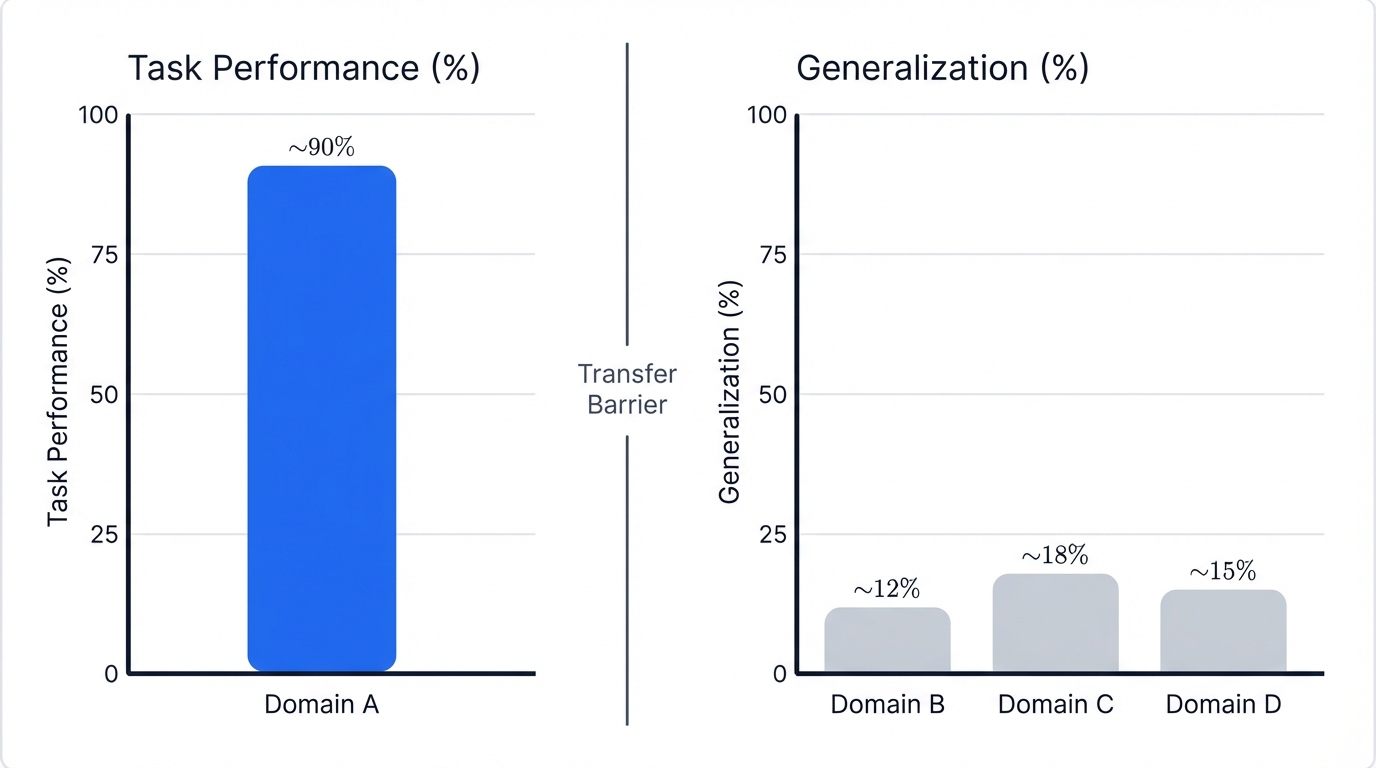
Key Concept: Understanding this foundational concept is essential for mastering the techniques discussed in this article.
Several defining characteristics shape ANI's identity. First comes its task-specific nature, where each system gets optimized for precise applications like spotting cats in photos or translating Japanese to English. These systems deliver high accuracy and efficiency within their designated realms, crunching numbers and recognizing patterns faster than any human team. Yet their limited adaptability creates an invisible wall, a barrier that prevents them from applying hard-won knowledge to fresh challenges, and this constraint reminds us that despite their impressive performance, these systems remain tools rather than thinking entities, dependent on the predefined instructions and meticulously curated data that their creators feed them during development and deployment.
Technical Architecture and Learning Approaches
ANI systems don't just appear from thin air. They rely on sophisticated technologies and carefully designed learning methodologies. Let's explore how these systems actually learn.
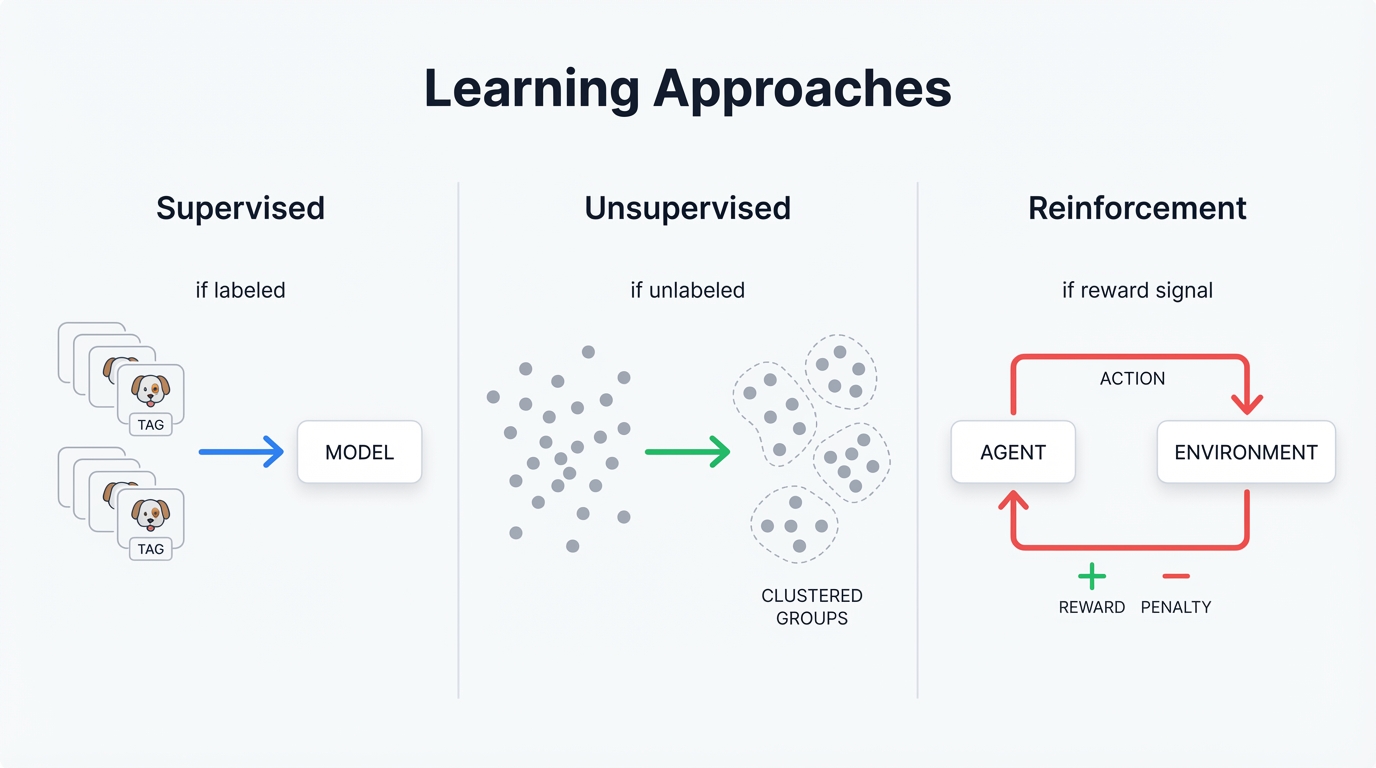
Supervised Learning forms the bedrock. You give the system labeled data. Lots of it. Show it thousands of images marked "cat" or "dog," and it learns to connect visual patterns with labels. This approach powers computer vision systems that now match or exceed human accuracy in image classification tasks. Simple concept. Powerful results.
Unsupervised Learning takes a different path, letting ANI systems hunt for patterns in data that comes without labels or guidance. Imagine a system analyzing customer behavior, discovering hidden segments and grouping shoppers based on purchasing patterns it identifies autonomously. This approach excels at clustering and association tasks, revealing structures in data that humans might miss, and it proves especially valuable in market segmentation where businesses need to understand diverse customer groups without knowing all the categories in advance.
Reinforcement Learning brings game theory to AI. Here's how it works: systems learn through trial and error, receiving rewards for good decisions and penalties for poor ones. AlphaGo demonstrated this brilliantly, playing millions of Go games against itself, refining strategies through countless iterations until it could defeat world champions. The system learned not from human instruction but from the fundamental feedback loop of victory and defeat.
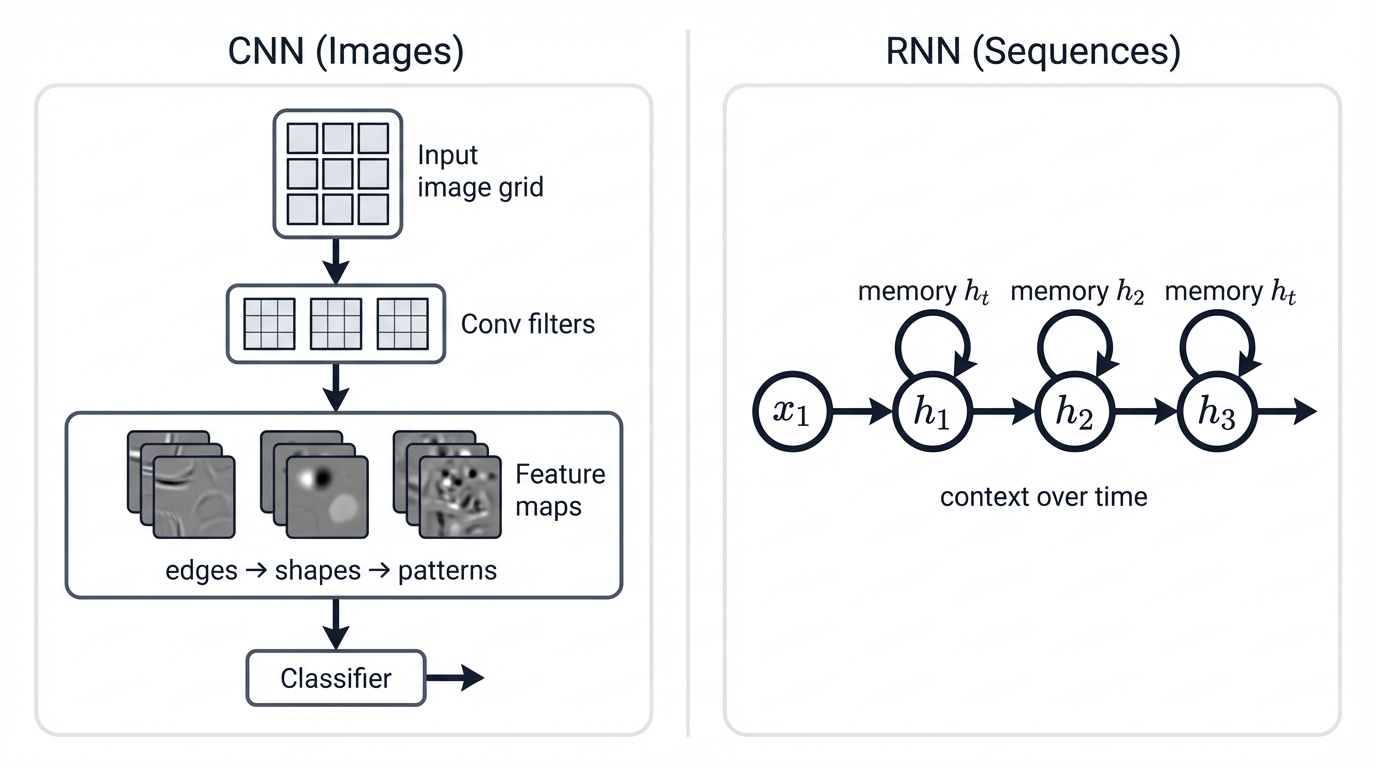
The technical foundation often uses Deep Learning and Neural Networks, with architectures tailored to specific challenges. Convolutional Neural Networks (CNNs) dominate image processing, detecting edges, shapes, and complex visual patterns through layers of specialized filters. Meanwhile, Recurrent Neural Networks (RNNs) handle sequential data like text and time series, maintaining memory of previous inputs to understand context and temporal relationships. These sophisticated architectures enable pattern recognition capabilities that seemed impossible just decades ago.
Real-World Applications and Examples
ANI isn't theoretical. It's everywhere. Transforming industries. Saving lives. Let's see where it makes the biggest impact.
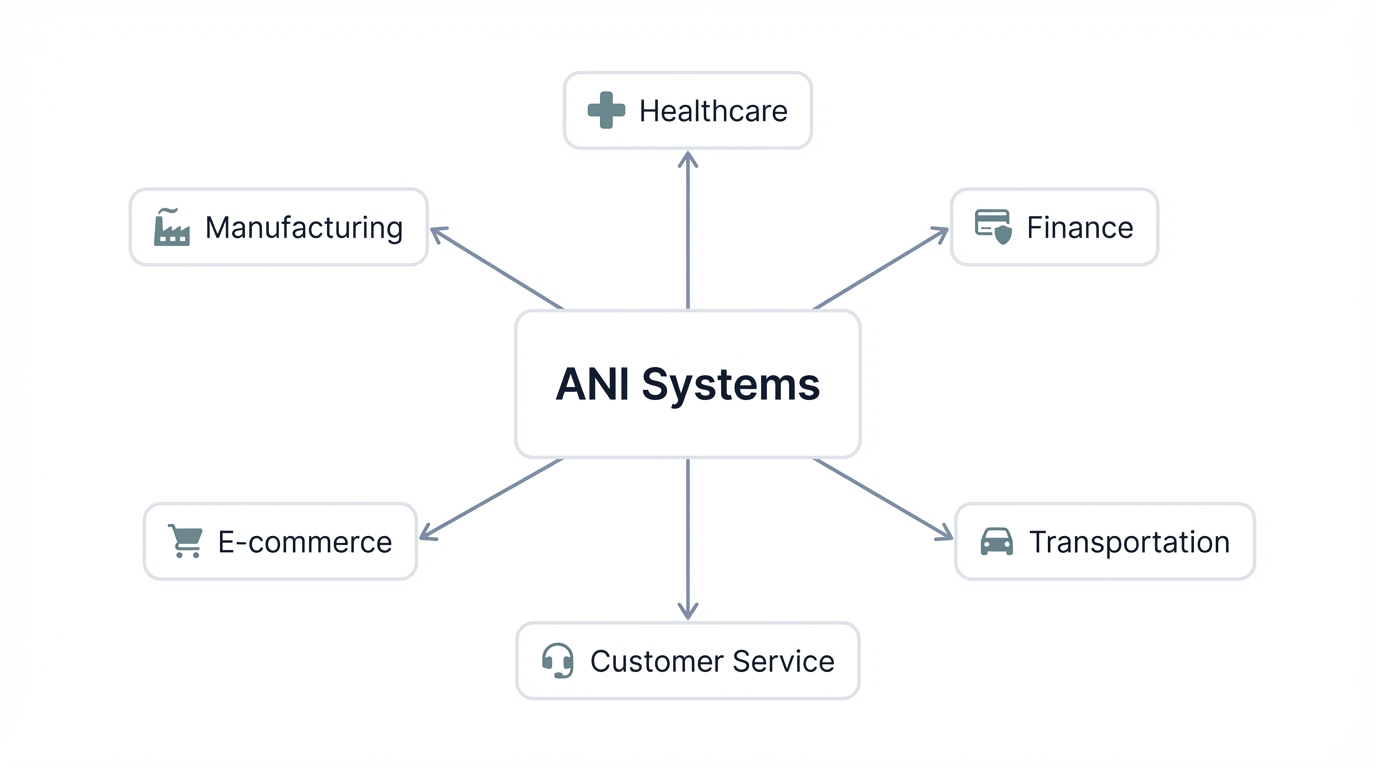
Healthcare applications show ANI at its most profound, where systems like PathAI assist pathologists in detecting cancer from tissue samples with speed and accuracy that amplify human expertise. These tools don't replace doctors but augment them, catching subtle patterns in medical images that tired human eyes might miss during long shifts. Early disease detection improves. Treatment planning becomes more precise. And healthcare costs drop as preventive care catches problems before they escalate into expensive emergencies.
Financial services bet big on ANI. Why? Because it spots fraud patterns invisible to human analysts. Banks deploy these systems to monitor millions of transactions per second, flagging anomalies that suggest fraudulent activity, while algorithmic trading platforms execute complex strategies based on market patterns that emerge and vanish in microseconds. Risk assessment models evaluate loan applications with consistency that eliminates human bias, and the numbers tell the story, with reduced fraud losses, improved credit decisions, and operational efficiency gains that transform profitability.
Transportation and automotive sectors push ANI to new frontiers through autonomous vehicles. Tesla's Autopilot. GM's Super Cruise. These systems process sensor data in real-time, navigating highways, changing lanes, and parking with capabilities that inch closer to full autonomy. The technology relies on AI-driven computer vision, radar processing, and decision algorithms that must react faster than human reflexes while maintaining safety standards that exceed traditional driving.
Customer service and virtual assistance bring ANI into our daily lives through voice interfaces like Siri, Alexa, and Google Assistant. These systems parse natural language, understand intent despite variations in phrasing, and execute tasks ranging from setting timers to controlling smart home devices. They learn user preferences over time, delivering increasingly personalized responses, though they remain constrained by their programming and can't engage in truly open-ended conversation beyond their defined capabilities.
E-commerce and recommendation systems drive engagement on platforms like Netflix, Amazon, and Spotify by predicting what you'll want before you know you want it. These systems analyze viewing history, purchase patterns, and behavior signals from millions of users, identifying subtle correlations that connect content and products to individual preferences. The algorithms process vast datasets continuously, refining recommendations to maximize user engagement and satisfaction while driving business metrics that prove their value.
Manufacturing and industrial applications use ANI for predictive maintenance and quality control that prevent costly failures and production defects. Siemens deploys AI systems that monitor equipment sensors, detecting subtle changes in vibration patterns, temperature variations, or electrical signatures that signal impending failures. These systems predict breakdowns before they happen, scheduling maintenance during planned downtime rather than responding to emergency shutdowns, and the result transforms manufacturing economics through reduced downtime, optimized maintenance spending, and improved product quality that strengthens competitive positioning.
Advantages and Business Value
Why does ANI dominate AI deployment? The advantages tell the story clearly.
- Cost-Effectiveness drives adoption decisions. ANI systems focus on specific problems. This targeted approach requires less development time than building general AI capabilities. Organizations invest in solutions for precise business needs, achieving faster ROI through focused implementation. The economics work because you're not paying to build intelligence; you're buying specialized capabilities.
- Operational Efficiency transforms bottom lines through automation of repetitive tasks that consume human time without requiring human judgment. These systems process data faster, maintain consistency across millions of operations, and eliminate the errors that creep into manual workflows, and the time savings compound as organizations scale these solutions across departments and processes.
- Scalability and Flexibility emerge from ANI's modular nature, letting organizations implement AI solutions for specific challenges without comprehensive system overhauls. Need fraud detection? Deploy that module. Want predictive maintenance? Add that capability. This approach builds AI capabilities incrementally, spreading costs and minimizing disruption while delivering measurable value at each step.
- Enhanced Decision-Making flows from ANI's ability to analyze datasets too large for human review, surfacing patterns and insights that inform strategic choices with data rather than gut instinct. Marketing teams optimize campaigns in real-time based on consumer response data. Supply chain managers adjust inventory based on demand forecasts that incorporate hundreds of variables. Finance teams assess risk using models that consider market conditions across multiple dimensions simultaneously.
Limitations and Challenges
Important Consideration: While this approach offers significant benefits, it is essential to understand its limitations and potential challenges as outlined in this section.
But ANI is not perfect. Far from it. Understanding these constraints matters as much as recognizing capabilities.
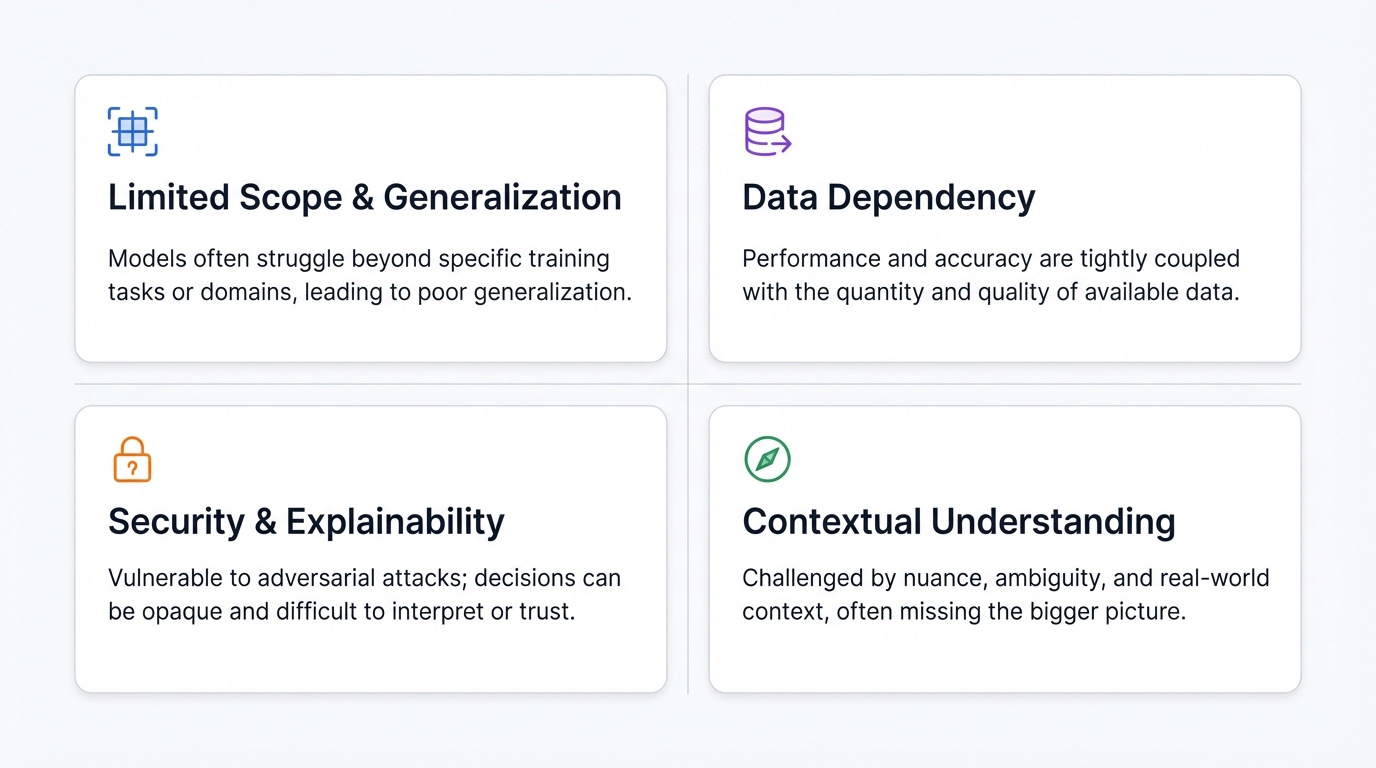
Limited Scope and Generalization represent ANI's most fundamental weakness: a chess-playing AI cannot drive your car, and a medical diagnosis system can't translate languages. These systems operate within rigid boundaries. They lack versatility. And they can't transfer knowledge between domains the way humans effortlessly apply concepts from one field to solve problems in another.
Data Dependency creates both technical and practical challenges that constrain deployment and performance. ANI systems hunger for data, specifically the massive, high-quality datasets that capture the patterns they need to learn. Poor data quality? The system learns incorrect patterns. Biased training data? The system perpetuates those biases in every decision. And collecting comprehensive datasets consumes time, money, and computational resources that many organizations struggle to marshal, creating a barrier to entry that favors well-resourced companies while limiting innovation from smaller players who lack access to massive data repositories.
Security and Explainability Concerns haunt ANI deployment in high-stakes applications. The "black box" problem plagues neural networks, which make decisions through millions of weighted connections that resist human interpretation. Why did the medical diagnosis AI flag this patient for additional testing? The system can't explain its reasoning in terms doctors find meaningful. This opacity erodes trust and creates accountability nightmares when AI decisions affect lives, finances, or legal outcomes. Adversarial attacks can also manipulate neural networks through carefully crafted inputs that humans would recognize as obvious fakes but fool AI systems completely.
Contextual Understanding Limitations expose how ANI differs from human intelligence in fundamental ways. These systems process patterns without grasping meaning or cultural nuance. Translation tools convert words accurately but miss idioms, cultural references, and contextual subtleties that native speakers navigate intuitively. Sentiment analysis systems struggle with sarcasm. Image recognition fails on unusual angles or lighting conditions. And chatbots derail when conversations venture beyond their training scenarios, unable to reason about novel situations or understand the deeper context that makes human communication so richly layered.
ANI vs. AGI: Key Distinctions
How does ANI compare to the artificial general intelligence researchers pursue? The differences illuminate both current reality and future aspirations.
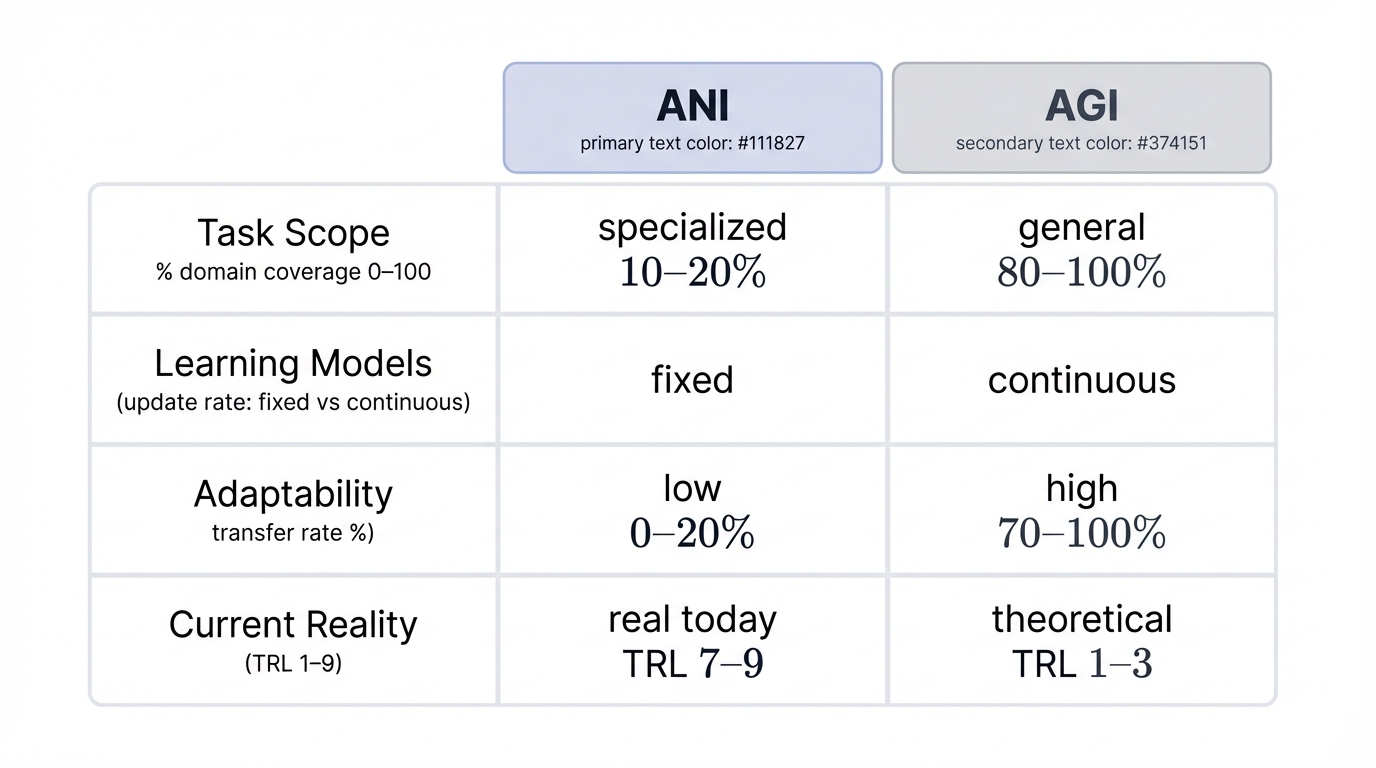
- Task Scope separates these fundamentally different approaches to AI: ANI excels at specialized tasks but stumbles outside its programming, while AGI aims to replicate human-like intelligence that handles diverse challenges across multiple domains. Think of ANI as a master specialist versus AGI as a versatile generalist.
- Learning Models diverge in flexibility and adaptation. ANI operates from predefined models with fixed responses to specific inputs, following programmed patterns like a sophisticated flowchart. AGI would learn continuously from its environment, adapting autonomously to new situations without human intervention, developing novel problem-solving strategies that weren't explicitly programmed.
- Adaptability reveals the performance gap. ANI demonstrates limited flexibility within specialized domains, requiring retraining or reprogramming to handle new scenarios, while AGI would exhibit high adaptability, applying knowledge across diverse contexts and learning from minimal examples the way humans grasp new concepts from brief explanations or single demonstrations.
- Current Reality grounds these comparisons in practical truth: ANI represents today's technology with proven applications transforming industries right now, while AGI remains theoretical, a goal that researchers pursue through various approaches but haven't achieved despite decades of effort and billions in investment, making ANI the only form of AI actually delivering business value at scale today.
Future Prospects and Evolution
Where does ANI go from here? Multiple trajectories emerge across different application domains.
- Healthcare Advancement promises enhanced diagnostic precision through deeper integration of machine learning algorithms that analyze medical images, genomic data, and patient records simultaneously. Future systems will likely predict diseases earlier with greater accuracy, tailoring treatments to individual genetic profiles and medical histories in ways that improve patient outcomes while reducing healthcare costs through preventive care that addresses problems before they require expensive interventions.
- Autonomous Systems Evolution accelerates as regulatory frameworks develop alongside technological capabilities. Continuous improvements in sensor technology, computer vision, and decision algorithms will enhance safety and reliability in autonomous vehicles and other automated systems. The convergence of better hardware, refined algorithms, and supportive regulations will expand deployment beyond limited pilot programs to widespread commercial adoption.
- Industrial Integration expands ANI applications in manufacturing and agriculture, driving productivity gains through optimized supply chains, enhanced quality control, and automated routine tasks that free human workers for higher-value activities. These implementations will help businesses operate more efficiently while advancing sustainability goals through resource optimization and waste reduction.
- Consumer Technology Enhancement brings deeper ANI integration into everyday applications, from smart home devices that anticipate needs to personal assistants that manage digital lives more effectively. These systems will understand context better, maintain longer-term memory of preferences, and coordinate across multiple platforms to deliver connected experiences.
- Edge Computing and Real-Time Processing enable more responsive ANI systems that make decisions locally without relying on centralized cloud infrastructure, reducing latency in critical applications from autonomous vehicles to industrial controls. This architectural shift will enhance user experiences while improving privacy and reliability through distributed intelligence that operates even when network connectivity fails.
Conclusion
Best Practice: Following these recommended practices will help you achieve optimal results and avoid common pitfalls.
Artificial Narrow Intelligence defines AI today. Not tomorrow. Now. These specialized systems deliver targeted capabilities that transform industries while operating within well-defined limits. Healthcare diagnostics. Financial fraud detection. Autonomous vehicle navigation. All rely on ANI's focused approach to specific challenges.
Yes, ANI has constraints (limited generalization, heavy data dependency, contextual blindness), but its practical applications keep expanding across fields, powered by advances in machine learning, deep learning, and neural network architectures that push performance boundaries while maintaining the task-specific focus that makes these systems economically viable and technically achievable, and this combination of proven business value and manageable implementation complexity drives adoption across organizations seeking to optimize processes and enhance customer experiences without waiting for the theoretical breakthroughs that might someday deliver artificial general intelligence.
As ANI continues evolving toward more sophisticated applications, it remains both a valuable tool addressing current challenges and a stepping stone toward broader AI goals, and understanding ANI's capabilities and boundaries proves essential for organizations deploying these systems, policymakers crafting regulations, and individuals navigating the increasingly AI-connected world where narrow intelligence touches nearly every aspect of modern technology.
Series Navigation
This is Part 2 of 4 in our AI Evolution series:
- The Evolution of AI: Overview - Part 1 of 4
- Artificial Narrow Intelligence (ANI) - Part 2 of 4 ← You are here
- Artificial General Intelligence (AGI) - Part 3 of 4
- Artificial Super Intelligence (ASI) - Part 4 of 4
Previous: The Evolution of AI: Overview - Part 1 of 4
Next: Artificial General Intelligence (AGI) - Part 3 of 4